
Fernunson Dental
How to Spot Avoid Dangerous Online Dental Misinformation
Learn how to spot avoid dangerous online dental advice. Protect your teeth, avoid harmful DIY trends, and stick to safe, professional oral hygiene.
August 30, 2026
Learning how to spot avoid dangerous online dental myths is essential for protecting your teeth and keeping your smile bright in the digital age. With a quick scroll through social media, you can find thousands of videos promoting DIY teeth-whitening hacks, homemade toothpastes, or alternative treatments for gum disease. While some of these tips seem harmless, many are based on unverified claims that can permanently damage your enamel and gums. Understanding how to evaluate online oral health advice is the first step toward maintaining a safe, effective daily care routine.
Misinformation vs. Disinformation in Dentistry
To protect your oral health, it helps to understand exactly what you are up against when browsing the internet. Experts make a clear distinction between two types of false narratives:
- Misinformation: This is false or inaccurate information that is shared without harmful intent—essentially, getting the dental facts wrong [8]. An example is a well-meaning social media user sharing a "natural" teeth-whitening recipe using highly acidic lemon juice, unaware that the acid actually erodes protective tooth enamel.
- Disinformation: This is false information that is deliberately created and spread to mislead people [4][8]. In the dental industry, this often involves bad actors fabricating success stories or scientific "proof" to sell unproven oral care products or DIY dental kits.
Whether a post is classified as misinformation or disinformation, relying on it can lead to severe, irreversible damage to your teeth and gums.
Key Indicators to Spot Avoid Dangerous Online Dental Claims
With so much content published daily, how do you separate evidence-based oral hygiene tips from harmful trends? Look out for these common red flags:
1. Emotional Triggers and Sensationalism
Online disinformation is intentionally designed to trigger a strong emotional response [4]. If a post uses sensationalist language—such as "What your dentist isn't telling you!" or "Whiten your teeth in 5 seconds!"—it should immediately raise concerns. As official public safety guidelines note, if a claim raises your eyebrows, it should raise questions [4].
2. Low-Quality Platforms and Spammy Advertising
Pay close attention to where the information is hosted. Credible dental advice is published on secure, official websites or peer-reviewed medical journals [1]. If an online article promoting a "miracle" dental cure is cluttered with spam banners for unrelated platforms like SLOT ONLINE TERPERCAYA or online gaming hubs like MAHJONG WINS, it is highly unlikely to be a trustworthy medical resource.
3. Lack of Verified Professional Credentials
Always check the author's background [7]. Is the person giving the advice a licensed dental professional, or are they an influencer with no clinical training? True dental experts ground their advice in established scientific consensus rather than personal anecdotes or viral challenges.
The Real-World Danger of Online Dental Myths
Falling for online dental myths does more than just waste your money; it directly threatens your long-term oral health and alters how you interact with professional care.
Erosion of Preventive Care
According to the British Association for the Study of Community Dentistry (BASCD), false dental narratives contribute directly to a reduced uptake of crucial preventive care [3]. When people opt for unproven online "hacks" instead of regular professional cleanings and checkups, minor issues like plaque buildup can quickly escalate into severe gum disease or tooth decay.
Damage to the Patient-Dentist Relationship
Relying on unverified web-based clinical claims can severely strain the relationship you have with your dental provider. Research highlights that the proliferation of online misinformation reshapes patient-provider interactions, posing direct risks to clinical trust, treatment adherence, and effective healthcare delivery [2][5]. When patients develop a deep-seated mistrust of dental professionals due to online scare tactics, they are far more likely to avoid seeking help until they are in severe pain [3].
Practical Steps to Verify Dental Information Online
Before you try any new oral hygiene routine or product you see online, take these practical steps to verify its safety:
- Look for Secure, Official Domains: Safe, official government websites use HTTPS and secure padlock icons [1]. Seek out information from trusted public health agencies, universities, or established professional dental associations [1][3].
- Use Fact-Checking and Image Tools: If a post features a dramatic "before and after" transformation, consider doing a reverse image search to see if the photo was stolen from a legitimate dental clinic's portfolio to promote a fake DIY product [4].
- Cross-Reference the Claims: Never rely on a single source. Check if the advice aligns with guidelines from major, recognized dental organizations [3].
- Spot Fake Social Media Accounts: Analyze the profile sharing the advice. Be skeptical of accounts that lack clear credentials, use generic stock photos, or exist solely to drive traffic to third-party sales links [4].
How to Safely Discuss What You Find with Your Dentist
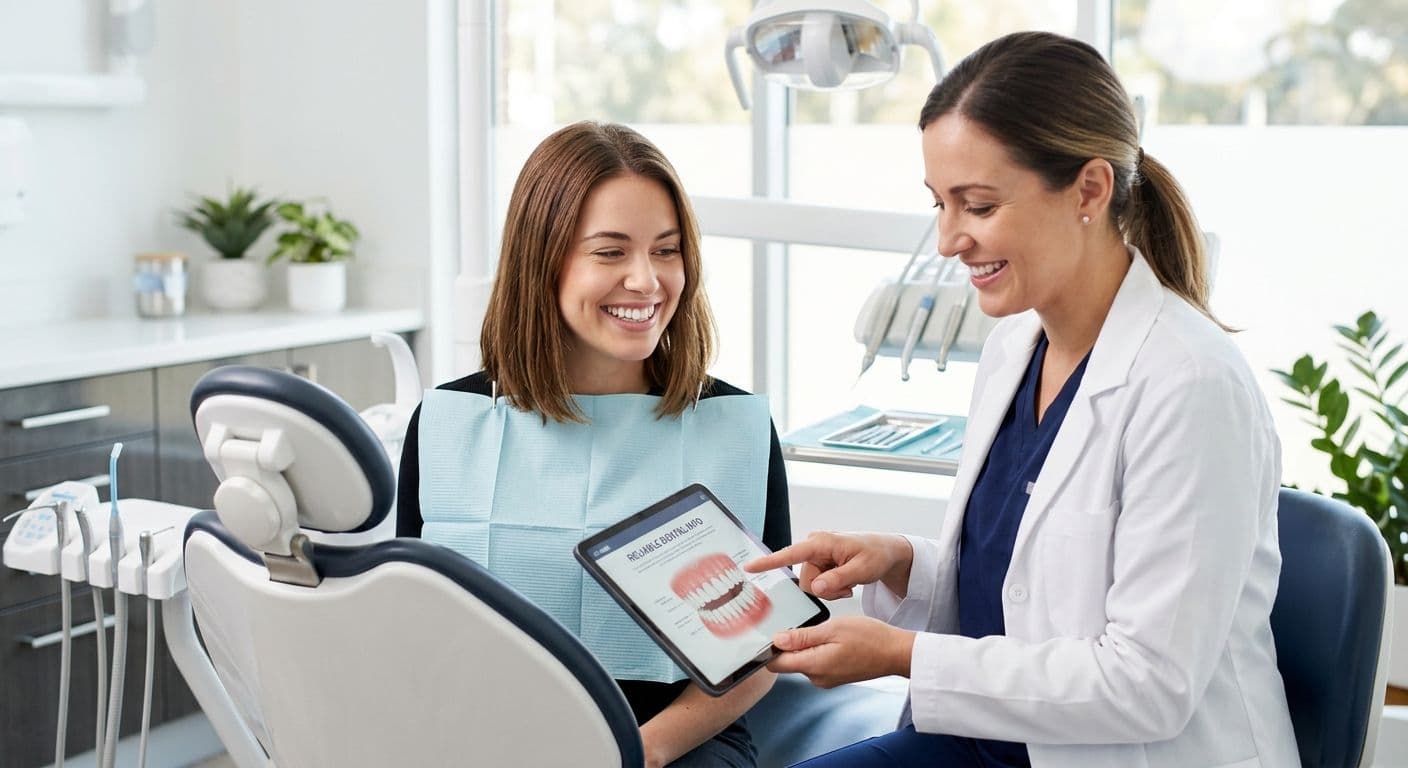
The absolute safest way to navigate online dental trends is to keep an open line of communication with your dentist.
Instead of experimenting on your teeth at home, write down the trends you are curious about and bring them to your next routine appointment [2][5]. Your dentist can explain the science behind why certain viral trends (like oil pulling or charcoal brushing) may or may not be safe for your specific oral health needs.
Additionally, we all play a role in keeping our communities safe. The U.S. Surgeon General emphasizes that individuals should learn to identify health misinformation so they can avoid sharing it and help friends and family do the same [6]. By stopping the spread of unverified claims, you protect not only your own smile but also the health of those around you.
Conclusion
A healthy, radiant smile is built on consistent, evidence-based habits—like daily brushing, flossing, and regular professional care. By learning to recognize emotional red flags, verifying source credentials, and avoiding spam-filled websites, you can safely navigate online spaces without putting your teeth at risk.
Are you curious about a dental trend you saw online, or are you simply due for your next routine cleaning? Contact your local dental office today to schedule an appointment and get personalized, evidence-based guidance for your smile!
Sources
[1] Exploring How People Interact With Dental Misinformation on Social Media: A Cross-Sectional Study — https://pmc.ncbi.nlm.nih.gov/articles/PMC10956376/ [2] The patient-dentist relationship and online misinformation — https://www.nature.com/articles/s41415-025-9312-0 [3] Tackling Misinformation in Population Oral Health — https://www.bascd.org/about/news/tackling-misinformation-in-population-oral-health-the-role-of-bascd-in-promoting-evidence-based-practice [4] Online disinformation — https://www.canada.ca/en/campaign/online-disinformation.html [5] The effect of web-based clinical misinformation on patient-provider interactions — https://www.sciencedirect.com/science/article/pii/S1357303925000726 [6] Health Misinformation — https://www.hhs.gov/surgeongeneral/reports-and-publications/health-misinformation/index.html [7] How to spot fake news | LearnEnglish — https://learnenglish.britishcouncil.org/free-resources/reading/b1/how-spot-fake-news [8] Misinformation and disinformation — https://www.apa.org/topics/journalism-facts/misinformation-disinformation